Screw Worm in Pima County
Dear 4-H and FFA Families,
Many of you know me as your fair veterinarian. I've had the privilege of working alongside your families and your animals for 27 years. I wanted you to hear the facts from me before the rumor mill gets any louder.
Here's where things stand. New World Screwworm has been confirmed in several Arizona counties, including a confirmed case in Pima County. It is officially in our backyard. That's a big deal, and I won't pretend otherwise and I suspect that it will be here for years.
But here's the most important thing I can tell you. Screwworm is treatable when it's caught early. The families who stay calm, check their animals every day, and act quickly are the ones whose animals will be fine. You don't need to panic. You need a plan, and that's what this email gives you.
WHAT IS SCREWWORM?
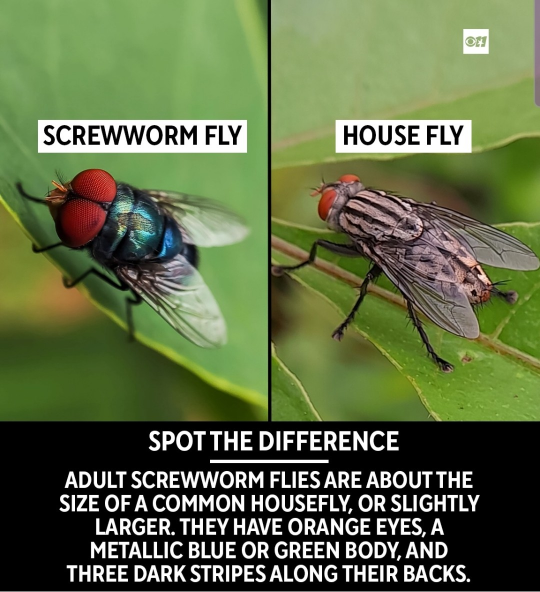
It's a fly. The female lays her eggs in open wounds or in moist body openings like the nose, eyes, ears, navel, or the area under the tail. The eggs hatch into maggots that feed on living tissue. That is what makes them different from ordinary maggots, which only eat dead tissue. Screwworm can affect any warm-blooded animal: cattle, horses, sheep, goats, swine, dogs, cats, rabbits, poultry, wildlife, and (rarely) people. It is not contagious. Animals don't catch it from each other. It comes from the fly.
No wound means no place to lay eggs. That's why your two best tools are simple.
CHECK FOR WOUNDS and CONTROL FLIES.
YOUR DAILY ACTION PLAN
1. Check every animal, every day.
Look them over from nose to tail. Look closely at:
- Any cut, scrape, or wire or fence injury
- Ear tag holes, castration and dehorning sites, and shearing nicks
- Navels on newborns, and the back end of anything that recently gave birth
- Tick bites, hot spots, and skin sores on dogs, cats, and rabbits
- Nose, eyes, ears, and under the tail
2. Know the warning signs.
- A wound that is getting bigger instead of healing
- A bad smell coming from a wound
- Bloody or brown drainage
- Maggots burrowed deep into the wound (screwworm larvae dig in head-first and are hard to pull out)
- An animal that is restless, head-shaking, or licking or biting at one spot, or that is off feed
3. Treat every wound right away.
Clean it and apply an FDA-authorized wound product for that species (see the list below). A small wound treated today is a non-event. A small wound ignored for a week is how this gets dangerous.
4. Get serious about fly control.
- Clean pens and stalls often. Manure and wet bedding are fly nurseries.
- Fix leaky waterers and muddy spots.
- Use fly traps, fly sprays, pour-ons, or ear tags labeled for your species.
- Pick up and dispose of spoiled feed promptly.
5. Plan ahead for procedures that leave an open wound.
Screwworm is likely to be with us for a while, so life on the farm can't stop. When your animal needs castration, dehorning, docking, tagging, or any other procedure that could leave an open wound, your veterinarian can give an injectable preventative at the same time to protect the site while it heals. At Adobe Veterinary Center, we have stocked up on injectable preventatives specifically for this purpose.
6. If you see maggots in a wound, call your veterinarian right away.
Don't just pick them out and toss them. If you can, drop a few into a sealed container with rubbing alcohol so they can be identified. Screwworm is a reportable disease, so your veterinarian will help you contact state officials. Calling early is the responsible thing to do, and nobody is going to be in trouble for it.
DON'T MEDICATE "JUST IN CASE"
I know the instinct is to treat every animal on the place to be safe. Please don't. The products work for a very short window, so giving them as a preventative does not necessarily protect your animal and wastes your money. It can also complicate withdrawal times on show and market animals. Use these products when there is a wound, a procedure, or an active infestation. Daily checks and good fly control are your real prevention.
THE GOOD NEWS: THERE ARE APPROVED PRODUCTS, AND MANY ARE OVER THE COUNTER
The FDA has conditionally approved or authorized for emergency use a growing list of products specifically for screwworm. Many of the livestock options are sold over the counter at your feed store or farm supply.
The official, up-to-date list (it changes often, so bookmark it):
Animal Drugs for New World Screwworm
Here's a quick guide by species (current as of mid-November 2026):
CATTLE (beef)
- Dectomax-CA1 (doramectin injection): over the counter, prevention and treatment
- Ivomec (ivermectin injection): over the counter, prevention
- Bimectin (ivermectin injection): prevention
- F10 Antiseptic Wound Spray or Barrier Ointment with Insecticide: prevention and treatment of wounds
- CLiK Extra wound spray: prevention
- Exzolt Cattle-CA1 (pour-on): prevention and treatment, ask your veterinarian
DAIRY CATTLE
- Dectomax/Dectomax-CA1, under emergency use. Check with your veterinarian before using it on any dairy animal.
HORSES
- F10 Antiseptic Wound Spray or Barrier Ointment with Insecticide: prevention and treatment of wounds
- Ivermectin Liquid for Horses (oral): prevention
- Dectomax (injection): prevention, ask your veterinarian first
SHEEP AND GOATS
- F10 Antiseptic Wound Spray or Barrier Ointment with Insecticide: prevention and treatment of wounds
- CLiK Extra wound spray: prevention
- Dectomax (injection): prevention in sheep only
SWINE
- Dectomax (injection): prevention
- CLiK Extra wound spray: prevention
DOGS AND CATS
- Their monthly flea and tick preventative: If your dog or cat is already on a monthly preventative such as NexGard, Credelio, Simparica Trio, or Bravecto (dogs), or NexGard COMBO or Credelio CAT (cats), you're already in good shape. These products are FDA-authorized against screwworm. If your pet isn't on one, now is the time to talk to your veterinarian.
- Capstar or generic nitenpyram tablets: over the counter, for treatment if you find maggots in a wound (pets at least 4 weeks old and 2 lbs). Please call your veterinarian.
RABBITS, POULTRY, AND OTHER SMALL ANIMALS
- There are currently no FDA-authorized screwworm products for these species. Keep their housing clean and check them daily. If you find a wound or maggots, call your veterinarian. Please do not try a dog or cat product on your rabbit.
THE RULE THAT DOES NOT BEND
If your animal is a food animal (market steers, lambs, goats, swine, meat rabbits, poultry), use only a product that is authorized for that species. Use it exactly as the label or FDA fact sheet says, and follow the withdrawal time. For these screwworm products, using them "off-label" is not allowed, even by a veterinarian. Before you treat any animal headed to a show or sale, check the withdrawal time with your veterinarian so it doesn't cost you your sale. I want every one of those animals walking into the ring in April.
A LITTLE PERSPECTIVE
This pest was eradicated from the U.S. once before, and state and federal teams are already releasing sterile flies in Arizona to do it again. Our job as owners is the unglamorous part: eyes on our animals, clean pens, and quick action. Kids who check their animals every day are already doing the most important thing. (And if your 4-H'er wants extra credit for record-keeping, a daily wound-check log would make any leader smile.)
If you see something that worries you, or if you aren't sure which product fits your animal, call your veterinarian. If you don't have one, my team at Adobe Veterinary Center is glad to help. I would much rather look at 50 wounds that turn out to be nothing than miss the one that matters.
Thank you for taking such good care of your animals and for being the kind of families who show up prepared. I'm proud to be part of this community, and I'll see you at the fair.
Christine Staten, DVM,
Fair Veterinarian
Adobe Veterinary Center